Value Discovery is a live generative artwork. It reads two Uniswap pools that quote the same token at different prices and renders the disagreement between them.
Value is discovered in the disagreement.
Each pool's price is run through a dithering algorithm, a process that tries to represent a continuous image using only discrete values. Every pixel the algorithm places is the wrong value. The error from each wrong decision gets distributed to neighboring pixels, who absorb it, make their own wrong decision, and pass new error forward. No individual pixel is correct. The collective distribution of wrongness produces, at a distance, something we treat as an accurate image.
A market does the same thing. Each participant makes a binary decision, buy or sell, based on incomplete information. Each decision is wrong. The error propagates through subsequent participants who inherit it as their starting condition. No individual trade is the correct price. The collective distribution of wrongness produces, over time, something we treat as the price.
Both systems distribute error until something useful emerges. Neither ever arrives at accuracy. Both are perpetual.
The word "value" does double work. Value as in price. Value as in the brightness of a pixel. Same word, same problem. A continuous reality that must be reduced to a discrete output, and the negotiation that happens in that reduction.
The token already had an existing liquidity pool at one fee tier. I created a competing one at a different fee tier, same token, different parameters, which means a different price. The disagreement isn't something I found. It's something I constructed. The artistic gesture starts at the infrastructure level.
Each price generates a dithered image of a US dollar bill using a different error diffusion algorithm. Two legitimate systems applying different rules to the same truth.
The artwork doesn't show either of those images. It shows where they disagree.
The work displays this disagreement as a grid of tiles in dollar bill proportions. Within each tile, the two dithered images compete for territory. Each image renders in its own color. You watch the colors push against each other, claiming and reclaiming pixels in the same space.
It's the same thing that happens between two prices for the same asset. Both are legitimate. Arbitrageurs force them toward agreement. One wins. The other gets absorbed. But until that happens, they coexist in tension. Neither is wrong. They just can't both be right at the same pixel.
One color dominates each tile. The loser survives only as scattered remnants, scars embedded in the winner's pattern.
Anyone can change the artwork by participating in either market. Buy or sell on either pool and you shift the spread, which shifts what is visible. The market is the medium. Its participants are the collective author.
Value Discovery needs disagreement to exist. When two pools agree on a price, the work goes quiet. When they disagree, the piece comes alive.
Every trade on pool B shifts the spread. Narrow it or widen it. Each trade is a decision under uncertainty that changes the conditions for the next person.
The system uses two Uniswap V4 pools that "compete" through economic friction:
Pool B's 6.9% fee means arbitrageurs only profit when the spread exceeds 6.9%. Below that, they ignore it — creating a gap that only organic market forces can close.
The system watches for spreads to drop below 0.1%. This 6.8% gap (between the 6.9% arb break-even and the 0.1% close threshold) is where the "competition" happens.
Once the spread exceeds 0.1%, a 10-minute maturation clock starts. This prevents flash loan attacks and ensures meaningful time passes.
When the spread drops below 0.1% after maturation, the epoch closes automatically:
The art evolves based on real economic forces — not timers or oracles. Each epoch close is a genuine market event where prices organically converged, making the resulting NFTs meaningful captures of blockchain activity.
Or collect the liquid edition. Anyone can collect at any time. Anyone can exit at any time. Supply responds to demand through a bonding curve.
Collect on SuperRareThe source image is a US dollar bill, downsampled to roughly 120 by 50 pixels. At that resolution, Washington becomes a dark blob. Text is illegible. Filigree becomes texture. You recognize it as a dollar without being able to read it.
The dollar bill is the most universally recognized symbol of consensus. Its value is not intrinsic. There is nothing about the paper or the ink that makes it worth anything. It works because everyone agrees it works. That agreement is the entire foundation.
In this piece, the consensus object only materializes through disagreement. When there is disagreement, the image appears. When there isn't, it disappears. Not because it was destroyed, but because the conditions that made it visible no longer exist.
Consensus doesn't produce the image. Disagreement does.
The colors are derived from the spread between the two market prices.
A midpoint hue comes from the transaction hash of the most recent capture. The two colors split symmetrically from this midpoint based on the size of the spread.
Zero spread: both colors identical, the image approaches emptiness.
Small spread: nearly indistinguishable colors, subtle disagreement.
Large spread: complementary colors, maximally opposed.
The chromatic distance between the two colors is the price distance. You can feel the size of the disagreement without understanding any of the mechanics.
When an arb event closes the spread, the colors rush toward each other and merge. The last frame of disagreement is captured. The arb transaction hash seeds the next spread's hue.
The destruction of one spread gives birth to the next one's visual identity.
Value Discovery launches as a liquid edition on SuperRare. Liquid editions flip the standard model. Instead of a fixed supply with speculative pricing, they create an open system where anyone can collect at any time, and anyone can exit at any time. The bonding curve is the market. Supply responds to demand in real time.
Using market state as artistic material is not about data visualization. It's not about making pretty charts out of price feeds. Market activity is human behavior. Every trade is a person making a decision under uncertainty. Every price movement is the aggregate of those decisions.
The liquid edition format aligns with what the work is actually about. Value Discovery is a piece about how markets produce coherence through distributed error. The liquid edition is itself a market producing coherence through distributed participation. The format is not a container for the concept. It is an extension of it.
An artwork about price discovery, living inside a price discovery mechanism, reading price discovery from the chain, and rendering it through a visual process that is structurally identical to price discovery.
Every layer is the same material.
When an arbitrage transaction closes the spread, the final frame is captured as an NFT. A record of something that no longer exists, frozen at the moment before consensus was enforced.
The first 32 captured spreads become NFTs arranged on a 4x8 grid. This mirrors the standard sheet format used to print real US currency, where 32 bills are printed on a single sheet. The printing sheet for consensus becomes the printing sheet for disagreement.
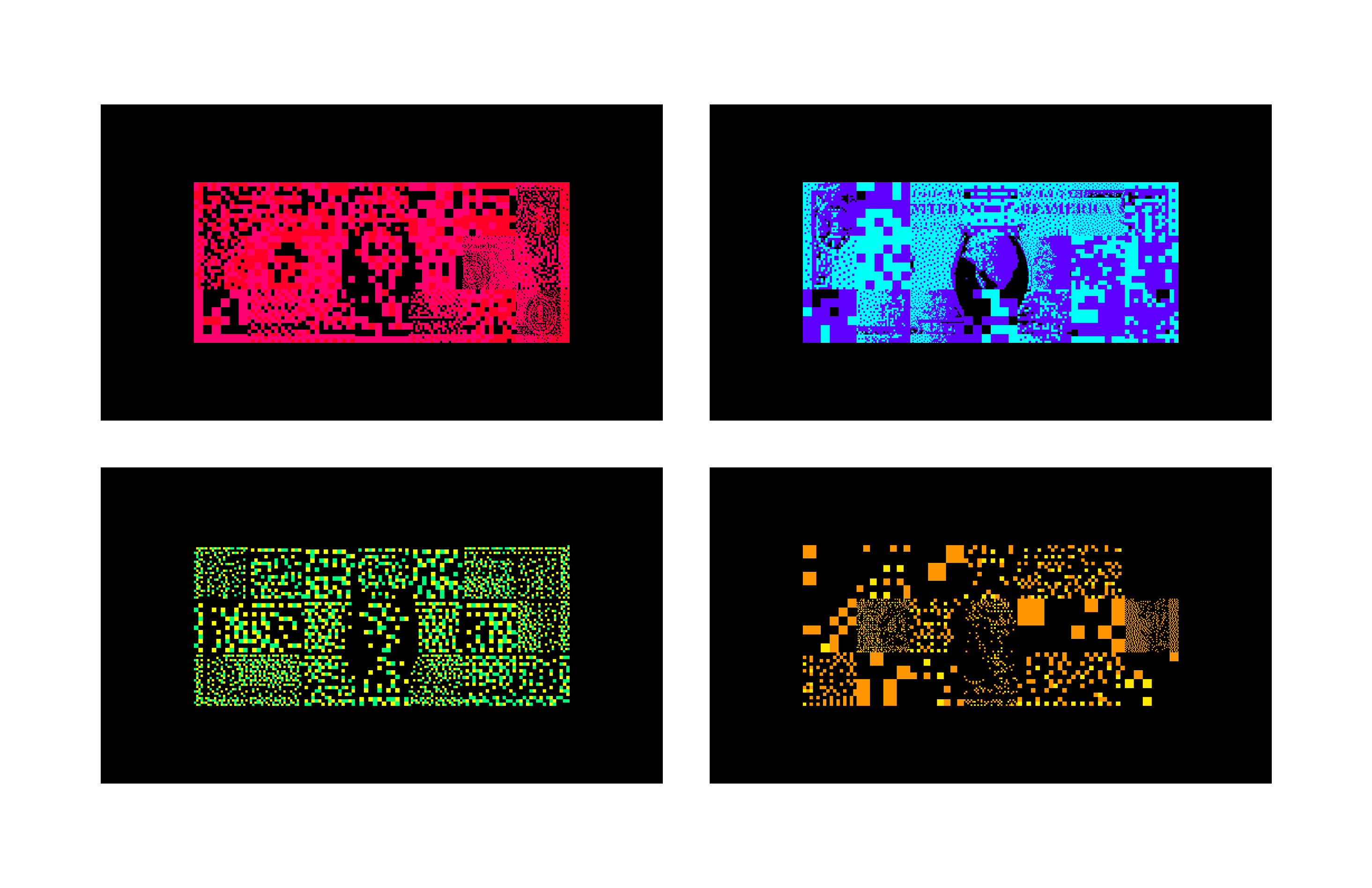
Each captured piece contains the specific color pairing at the moment of capture, the grid state, the number of error cascade passes during that spread, and the arb transaction hash as onchain proof of the specific trade that killed the disagreement.
The rarity system is not artificial. Near complementary color pairs mean the disagreement was massive. Rare, because large spreads get arbed quickly. They are too profitable to leave open. Subtle pairs mean tiny disagreement. Common, because small spreads persist longer.
The most visually dramatic pieces are the rarest because the market conditions that produce them are the most unstable.
Maximum beauty equals maximum disagreement equals maximum economic incentive to destroy it.
Most of the time, efficient markets tend toward agreement. The work does not resist this or fabricate drama. When there is nothing to see, there is nothing to see.
That honesty matters. The piece breathes with the actual state of the system it observes. It is not a simulation. It is a direct readout of real disagreement, rendered through a process that is itself a form of disagreement resolution.
After arbitrage, you don't get a more accurate price. You get two prices that agree with each other.
Agreement is not accuracy. It is the absence of exploitable difference.
Dithering never arrives at truth. Neither does a market. Both produce something we agree to treat as truth because the alternative is admitting the system is nothing but elegantly distributed error.